Darkmass.io Strategy Guide
The How to Play page explains the rules. This page teaches the decisions: what to farm, when to hunt, when an ability is worth its price and when it is not, from your first orb to the top of the board.
PlayLast updated 11 July 2026.
The opening
A new run starts you among Stars about your own size, shielded for the first few seconds. Nobody around you can hurt you yet, and for now nobody is food either, so there is no fight worth picking. The opening is about lines.
Your first orbs are worth extra, and that bonus is the cheapest growth of your whole run. While it lasts, every second you are not eating is a second wasted. Pick the direction with the thickest spread of orbs and drive through it in one smooth curve. Your Star quietly pulls in orbs that pass close, so a clean line through a field beats darting from orb to orb. Detour for anything pulsing violet: one Bright orb outweighs a long stretch of Ambient ones.
Do not spend abilities yet. Dash burns mass you barely have, and there is nothing to reel in that you could actually swallow. Bank the bonus, stay small and quick, and let the arena show you where the traffic runs.
A note for the second run: if your killer is still alive when you play again, you respawn near them, and the death screen has already told you who they are. Treat it as an invitation rather than an obligation. They are slower than when they got you, and you are tiny again. Farm first. Settle the score later.
Reading the arena
Orbs come in three kinds, and each kind tells you something.
- Ambient orbs are everywhere and always refilling. They are your floor: steady, safe income that is never worth a fight.
- Scatter orbs are a story. They burst out where a Star died, or drop where one is being worn down, so a fresh patch is a payout with a warning attached: whatever did the killing was here moments ago and may still be.
- Bright orbs pulse violet, appear at random and fill events. They are where the real income is, and the crowd knows it.
One event is always live, and the top of the screen gives you the next one a few seconds early: an arrow for where, a countdown for when. Read the arrow as a forecast of where everyone will soon be. Arrive early and farm the zone while it is still thin, or go the other way and sweep the ground the crowd has just abandoned. Both are good plays. Standing in the middle of a full event as a middling Star is not.
Sizing up neighbours is the other half of reading. A Star can only swallow you if it is about a quarter bigger than you and covers your centre, and a quarter is a visible difference. Clearly bigger is danger and clearly smaller is food; anything near your own size can do nothing to you yet, and you can do nothing to it. The trap is that sizes drift. A neighbour who farms one surge while you watch may have crossed the line, so keep re-checking the Stars you share ground with.
The middle game
Once the early bonus is gone, every decision is farm or hunt. Farming is steady and quiet. Hunting pays most of a victim's mass in one bite, but it costs time, position and usually an ability. Hunt when the target is clearly smaller, alone and pinned against something: a void, a hazard shower, a core about to blast. In open ground, chases rarely pay; you are the bigger, slower one, and the pursuit is paid for out of your own mass.
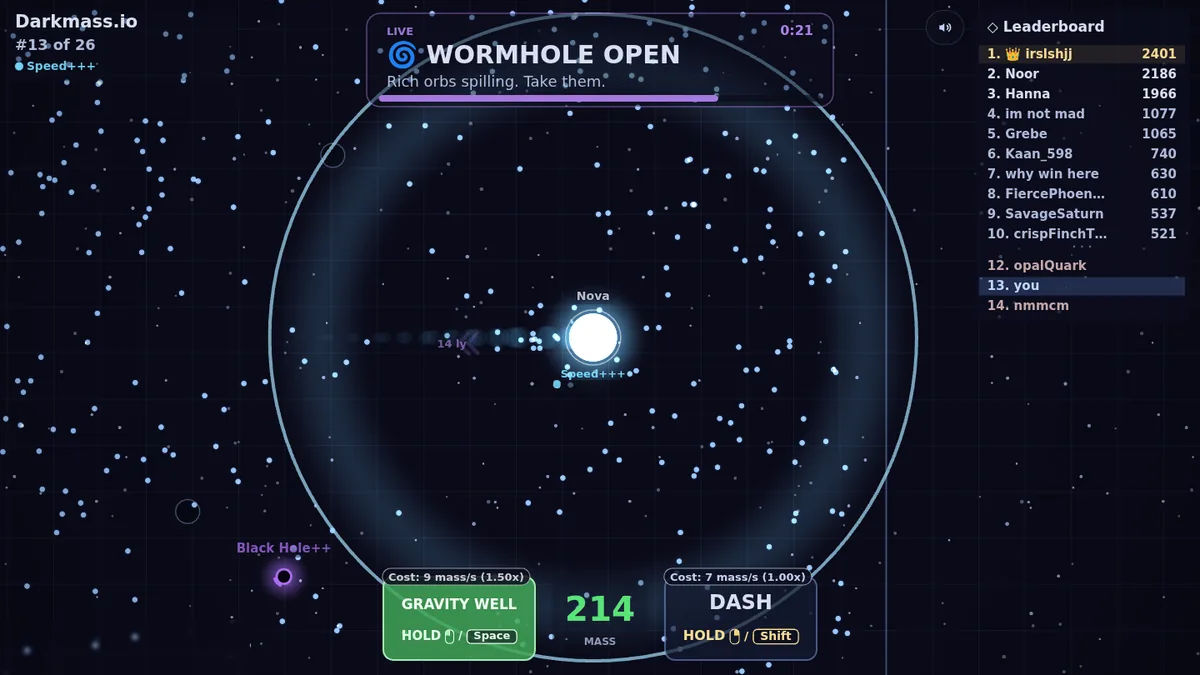
The Gravity Well is the middle game's main economic decision, because its price is not flat. The cost per second ramps the longer you hold it, and the whole price grows with your size; the ability box shows it live, the mass per second with the current multiplier beside it. Watch that multiplier climb through one long hold and the lesson sticks. The first moment of a pull is the cheapest it will ever be, so pulse: a burst over a dense patch, release, let the multiplier wind back down, pulse again. The wind-down is not free either. The price recovers more slowly the bigger you are, so a giant pays twice for sloppy habits.
The well has two jobs, and they are priced differently. Vacuuming a patch is a short, cheap pulse: take the orbs in reach and release. Reeling prey is a long hold at a climbing price, and it is only worth paying if you finish, because the swallow returns most of their mass and settles the bill. A reel you abandon halfway is pure loss. If the multiplier is high and nothing is arriving, you have already made the wrong decision: release and reposition.
Playing small and playing big
Size sets your role. Small means quick, several times quicker than the board's giants, and that speed is a currency. You choose your fights, disengage at will, reach events first. You can even graze the edge of a hazard that would tear a giant apart, because both hazards do more damage the bigger you are.
A big Star trades all of that for presence. Everything nearby is food and your quiet pull is wide, but you are slow, your abilities are expensive, the hazards bite harder, and events are drawn toward the leader, so the top of the board is also the centre of the weather. The crown is visible to everyone, and a giant cannot outrun any of them. If you lead, position is everything: stay near your food, keep the void off your back, and accept that holding the spot costs mass. Big is power, not safety.
The sharpest small-Star play is the leech. Take a Black Hole power-up near a giant: for a few seconds the pull flips in your favour (the heavier they are, the harder they are dragged toward you), contact grinds mass off them, and you are untouchable for the duration. Run at the leader, grind their edge, hoover up what they shed, and use the brief moment of protection when it ends to cover your exit.
The event playbook
Light surge
Bright orbs flood a single zone. Arrive on the countdown and work the rim first: the rim has escape routes, the centre has company. Decide in advance how long you will stay, and leave while you are still one of the smaller Stars in the zone; the fight that starts when the orbs run out is not one you want to headline.
Wormhole
A wormhole pours out orbs of higher value in a thicker bloom than any surge, which means a bigger payout and a bigger crowd. It is the best place in the game for a short Gravity Well pulse: one burst over the bloom takes a large share at the cheap end of the price ramp. Then release and watch: everyone who fed here is heavier and slower than when they arrived, and some have just crossed into being food.
Supernova
A supernova telegraphs itself: the core swells on its countdown, then detonates. Standing in the blast costs you a slice of mass but can never finish you off, so the decision is plain arithmetic. If you can afford the chip, stand close, take the hit and be first onto the burst of bright orbs while cautious players are still walking in. If you are already worn thin, the blast will not end you, but the Star next to you might, so weigh the company first.
Black hole
A void opens and starts dragging in Stars, orbs and power-ups, destroying whatever reaches the core. The rim is another matter. Anything that dies near it spills Scatter orbs for the survivors, so hunt along the rim with the pull at your target's back, never at yours. And remember the void punishes size: the bigger you are, the wider your berth. A giant should treat the whole neighbourhood as closed.
Hazard shower
Dark shards fall across one patch of the arena for a while. If you are big, leave; the shards chip harder the bigger you are. Small Stars get the opposite deal. The same rain only nibbles them, which turns the shower into a private farm, and grazing its edge while the giants wait outside is one of the quiet ways a small Star out-earns the board.
Power-up decisions
Power-ups come in three grades, and you can read the grade off a pickup's size before you commit to the detour. Grabbing a second of the same kind refreshes the timer and keeps the higher grade, but never stacks past the top. Two small pickups do not add up to a big one, so a duplicate is worth a detour and nothing more.
Gravity against Speed is a question about your current problem. Gravity makes your pull stronger and longer-reaching, so it converts a place into profit: take it when you are standing somewhere rich, a surge, a wormhole, a fresh scatter field, or when you are setting up a reel. Speed turns distance into safety or a kill, and it stacks with Dash, which makes the pair the strongest escape in the game: take it when the problem is a gap, a hunter behind you or prey ahead. The mistake is grabbing whichever is closest. Gravity with nothing worth pulling and Speed with nobody to run from are both a wasted grade.
The Black Hole is the timing pickup. It lasts a few seconds, so those seconds have to count. Do not grab it on sight: note where it drifts and come back when the moment is right, with a giant in leech range, a crowd worth scattering, or a hunter about to cover your centre. For those few seconds you are untouchable: no Star can swallow you, no hazard can chip you, and an event's own black hole becomes prey if it is smaller than you, so the moment can be bolder than feels natural. A Black Hole taken with a plan changes a run; taken by reflex, it expires over empty ground.
Escapes and duels
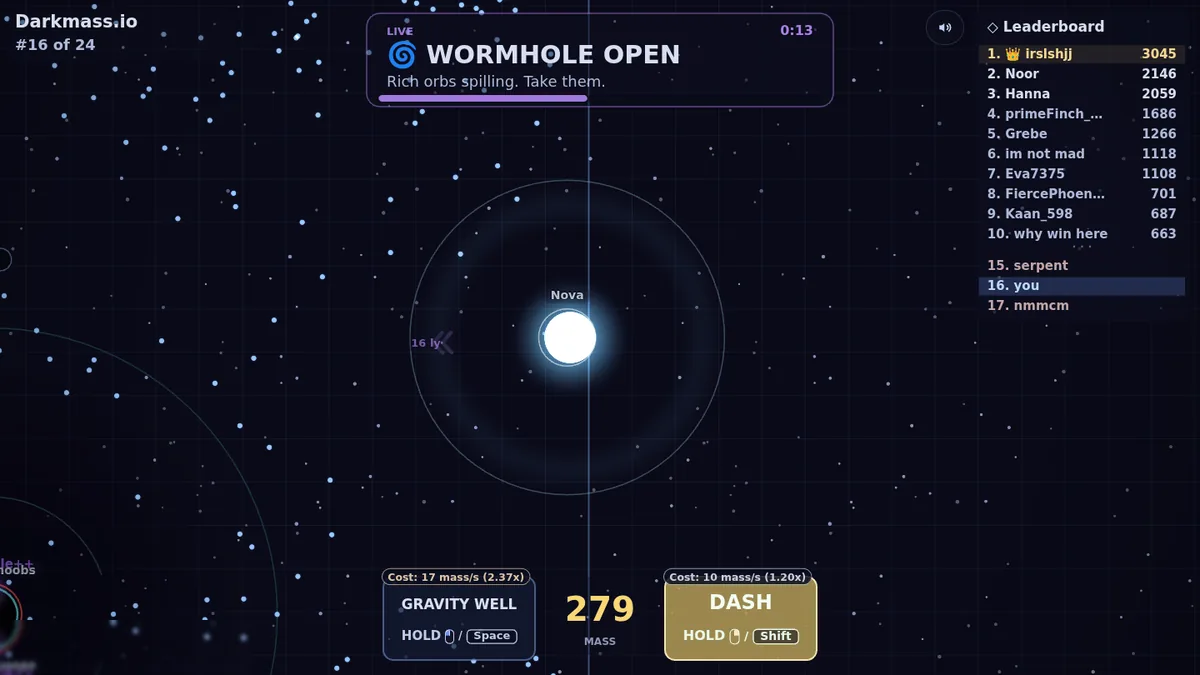
Dash has a price tag most players never read: it burns mass quickly and trails it behind you as collectible orbs, and the Star chasing you is running exactly where that trail falls. A straight-line dash literally pays your pursuer to keep coming. So dash to break the line, not to win a marathon: one burst at a hard angle, then use your natural speed. If you are the smaller Star you are already the faster one, and often you do not need Dash at all, just a clean corner. Save it for the moment that demands it, a Gravity Well starting to reel you in, or a Star that has turned into a black hole making its run at you.
Break chases with geography. Both hazards punish your bigger pursuer more than they punish you, so a chase dragged past a void's rim or through the edge of a hazard shower taxes them at a rate you can afford and they cannot. A supernova on its countdown is cover of a different kind: the blast chips you both, and the burst of orbs it throws out brings the crowd, the last thing a hunter mid-chase wants.
Duels between near-equals are economy races. Neither of you can swallow the other until someone gets about a quarter bigger, so the duel is decided by who wastes less. Watch your price line and their habits: a rival who cruises with the well held is paying the ramp and drifting toward the threshold from the wrong side. Eat what spills, spend nothing you do not have to, and let their impatience do the growing for you. Patience, in a duel, is a weapon with no cost per second.
Common mistakes
- Cruising with the well held. The ramp guarantees that a long hold is the worst-priced pull you can buy. Pulse it, release, let the multiplier fall.
- Growing without a plan. Mass is your score, but it is not safety: every point makes you slower, pricier and more hunted. Grow toward something, an event, a power-up, a kill you have set up. Bigger on its own is not a plan.
- Contesting every event. The biggest payouts draw the biggest crowds. Some of the best income in the game is the quiet ground everyone else just left.
- Spending Dash on everything. Every burst costs mass and drops a trail your hunter eats. If you are not breaking a chase or finishing a kill, keep it in reserve.
- Ignoring the price line. The ability boxes show what a held ability costs right now, and the multiplier shows how far it has ramped. If the number is climbing and nothing is coming in, release. The game tells you when you are overpaying; the mistake is not looking.
Most of this comes down to one habit: before you hold an ability, chase a Star or follow the crowd into a zone, know what is on the other side of the spend. The rules behind everything here are on the How to Play page, shorter answers live in the FAQ, and the Updates page lists what has changed since this guide was written, so if a tip here stops matching the game, check there first. Corrections and tactics we missed go to [email protected].
Play